Friday, May 01, 2015

Fairy Tale Friday--The Enchanted Flower

This week's collection is Fairy Tales from the Harz Mountains.  The Harz Mountains are in Germany and are full of medieval  castles. (Note: I fixed the links. Sorry about that!)

 The Enchanted Flower, page 81, is like the continuation of the Apollo and Daphne story. It begins with a flower that used to be a woman who didn't want to marry the Count of  Lauenburg.  She avoids him by turning into a white flower.  The tale deals with how the flower becomes a woman again: the right person has to pluck her.  In this case, the right person is a young woman about to be married.


Friday, April 24, 2015

Fairy Tale Friday

This week's Google book is Tales and Traditions of the Eskimo containing the story The Blind Man who Recovered His Sight.  A cruel mother blinds her son--the son recovers his sight--the son and daughter kill the mother--there are consequences for matricide.

Friday, April 17, 2015

Fairy Tale Friday--The Gold Giving Serpent

The fairy tale for this week is from India: Indian Fairy Tales by Joseph Jacobs.

Now here's a portion of the entry "sacred Animals" from Brill's Encyclopedia of Hinduism regarding the Cobra:

Nāga: The Snake

Of all the animals worshipped in India, the cobra snake has probably been the most important and has the longest history. A very complex symbolism and history are attached to the sacred snake in Hinduism, and snake worship has multiple origins and represents a plurality of traditions. Snake worship includes the direct worship of the fearsome and dangerous living snakes, worship of the nāga deities associated with water, and the conception of the vedic Vṛtra connected to the cosmic struggle of the god Indra. Vṛtra, the enemy of Indra in the Ṛgveda, is also called Ahi (“Snake”) and might refer to a primordial snake in control of the cosmic water. The word for the divine snake is nāga, which is also the name of tribes of humans, and elephants are called nāga as well. Nāga as a name for snakes is used mostly only for cobras as divinities. “The Nāga of Indian mythology and folklore,” wrote J.P. Vogel, “is not really the snake in general, but the cobra raised to the rank of divine being” (Vogel, 1926, 27). In the early Ṛgveda and in the Atharvaveda, the word ahi is used for snakes as well as mythological serpents. In the later part of the Veda, sarpa is used. The word nāga appears in the Brahmaṇas the Mahābhārata and the Purāṇas (and the Buddhist Jātakas), and here nāga is used only for the mythological serpents, while snakes living in nature are called sarpas. In Amarakośa, a Sanskrit lexicon, nāga is not listed as a synonym for snake. Cobras, in contrast, are called nāgas, and in religious art, nāgas typically have cobra hoods in both their zoomorphic and anthropomorphic shapes (Semeka-Pankratov, 1979; Vogel, 1926).
The nāgas are connected to water – to rain as well as the dark, creative, cosmic waters of the underworld. They are thought to hide in the interior of the earth and to appear on the surface, particularly during rainy season. They inhabit lakes and rivers, and the ocean is said to be their abode. The cobra was often thought to reside under trees and in the anthills, which were thought to be entrances to the underworld. The snake world (Nāgaloka) is described in the Mahābhārata as a delightful abode full of wealthy palaces, and the cobra was therefore thought of as guardian of treasures. The nāgas are associated with weather phenomena such as rainstorms and lightening and are believed to control the rain. The poisonous snake represents danger and power over life and death. The snake leaving its skin behind symbolized longevity or immortality, and it is a simile of mokṣa (liberation) and of the way one who is liberated leaves evil behind (Vogel, 1926).
Hinduism contains a rich nāga mythology. The nāgas are important figures, especially in the first book of the Mahābhārata, the Ādiparvan, which contains numerous nāga stories (in the Pauṣya, Puloman, and Āstīka chapters), but narratives about sacred snakes are found throughout the Mahābhārata (Minkowski, 1991). King Janamejaya’s snake sacrifice (sarpasattra) in the Khāṇḍava Forest is the frame story of the Mahābhārata (Minkowski, 1991).The story of the origin of the nāgas is told in connection with the snake sacrifice. The nāgas are presented as sons of Kadrū, whose sister Vinatā is the mother of Garuḍa. The nāgas and Garuḍa are enemies, and enmity of Garuḍa and his cousins the nāgas is a favorite theme in Indian literature and art (Vogel, 1924). Kadrū fraudulently won a bet against Vinatā, and those of Kadrū’s sons who had refused to be partners in the fraud were to perish in King Janamejaya’s sacrifice. The sacrifice was to be performed because of the violent death of his father Parikṣit, who, while hunting, met a sage who had taken a vow of silence, so Parikṣit insulted him by throwing a dead snake round his shoulders when he did not answer. The son of the sage cursed the king: on the seventh day, the lord of snakes Takṣaka was to take the king to the god of death, Yama. The king took all possible precautions, but at the end of the seventh day, the king ate a piece of fruit with a small worm inside. The worm, it turned out, was Takṣaka, who, after he had been eaten, assumed his real form and bit the king. The bite killed the king, and the heat of the poison even caused the palace to burn down (Vogel, 1924). One of Kadrū’s sons, the snake Śeṣa (“Remainder”), who is also called Ananta (“Without End”), secluded himself from his brothers and became an ascetic with matted hair and bark garments. When Brahmā asked him what was the aim of his asceticism, Śeṣa answered that he refused to stay with his brothers who hated Garuḍa and one another. Śeṣa chose the boon from Brahmā that his mind would rejoice in righteousness, tranquility, and asceticism ( tapas ). Brahmā asked him to bear the earth, and since then Śeṣa has carried the earth on his head, enveloping her in his coils (Vogel, 1924). A dominant theme of the Mahābhārata is the pralaya (destruction) and the end of a yuga (era; see cosmic cycles). Only two survive this pralaya, and one of them is Śeṣa, whose name signifies this fact (Minkowski, 1991). Another nāga of importance is Vāsuki, who had been anointed as king of nāgas, according to the Mahābhārata (Ādiparvan), and who was the snake used as rope around Mount Meru by the devas and asuras for churning the ocean.

Courtesy Wikimedia Commons

Friday, April 03, 2015

Fairy Tale Friday--Old French Fairy Tales


This week I'd like to tout this whole book, because all the illustrations are gorgeous!  I'm including some of the color plates here, but don't miss the black-and-white ones in the book.

by Sophie Segur
Illustrations by Virginia Frances Sterrett


Friday, March 27, 2015

Fairy Tale Friday--The Month of March

For the last Friday in March, I would like to feature the story The Month of March on page 42 of Italian Fairy Tales by Georgene Faulkner.  This is the first fairy tale I've read that features personified months; seasons, sure, but not months.


It also includes the very common theme of two people (in this case a rich brother and a poor brother) getting a completely different results from an encounter with the same supernatural being(s).

Friday, March 20, 2015

Fairy Tale Friday--Aino Folk-tales

The Ainu are an indigenous Japanese people.  This collection of tales aimed at academics hasn't got any illustrations, so I've added one from a Dover clip art collection.


Aino Folk-tales by Basil Hall Chamberlain

The story I would like to feature is The Man who was changed into a Fox on page 25.  Foxes appear frequently in Japanese folklore. They generally disguise themselves as women, or possess the souls of women,  so that makes this story an interesting exception.

Friday, March 13, 2015

Fairy Tale Friday--Urashima

Japanese Fairy Tales  By Teresa Peirce Williston has lots of color illustrations.  I'd like to tout the story Urashima.  It's a Japanese version of Rip Van Winkle.


Not from the book

Friday, March 06, 2015

Fairy Tale Friday--Prince Hat Underground


This title caught my eye because I love hats.  The tale, as told starting on page 187 of the collection Swedish fairy tales. Translated by Tyra Engdahl and Jessie Rew., never explains why he is Prince Hat.  Does he favor hats over crowns?  Is his head particularly important?

Another interesting element is the "singing leaves," which the good daughter (pictured above) asks her father to bring her.  Of course, her request for this weird gift gets her away from her father into the realm of Prince Hat Underground.  She has to live with him without seeing him, but (as in the story of Cupid and Psyche) she sneaks a look at him while he's sleeping, which makes him leave.  Then she has to go through a lot of rigamarole to get him back.

It's a very long, complicated story with many motifs.

Friday, February 27, 2015

Fairy Tale Friday--a New Series

I love fairy tales, and thanks to an army of 19th C tale-collectors Google Books has lots of copyright-free ones.   In honor of Open Access Week, I'm going to search out ones that interest me and feature them here on Fridays.


This tale includes several common folklore motifs:  A father is fooled into giving his child to a supernatural being (pictured above) (Thompson S241)*;  the child (in this case a son) is trapped in the SB's realm and is set, by said SB, several impossible tasks (Thompson H900), which the son accomplishes with directions from a woman (Princess Sigorra) (Thompson K1848); The son is finally able to flee with the aid of PS;  The son returns home, and, because he does not follow her instructions, he forgets PS.(Thompson D2003); The son's family arranges for him to get marries, and SB has to resort to complicated tricks to get to him and refresh his memory.


* Thompson, Stith, Motif-Index of Folk-Literature


Monday, April 21, 2014

Easter Without Eggs

My neighbor and I went to the MFA to see the Quilts and Color exhibit.  Fortunately, Easter-related activities kept the crowds elsewhere, so we could see the quilts easily.  I bought the catalogue for this exhibit.

Next, after a lovely meal at Cafe Jaffa, Rosemary and I strolled to the Marathon finish line to check stuff out.


On Patriots' Day I am back at work, since Harvard is not patriotic enough to give us the day off.  Chris has used rubber bands to make love beads.

Wednesday, March 26, 2014

Tipping Point

JB's boxes of CDs are dangerously unstable.


Monday, March 24, 2014

All Books Contain Mistakes..

..but some mistakes are better than others.  We were talking about this last week, so I decided to scan the title page of the Library of America volume 24  that misspelled "Melville."


The publisher offered to replace the volume, but Jon Lanham decided to keep it.

Wednesday, January 15, 2014

Policy Change

"Photography by students, faculty, staff and guests (such as visitors to parents’ weekends) using hand-held, self-contained cameras is permitted so long as it respects the privacy of library patrons, does not disrupt or interfere with the scholarly environment, the work of library users or staff or the safety of the collections and abides by copyright law. Personal photographers should not record any library patron without prior consent, and photography cannot be used for commercial purposes."

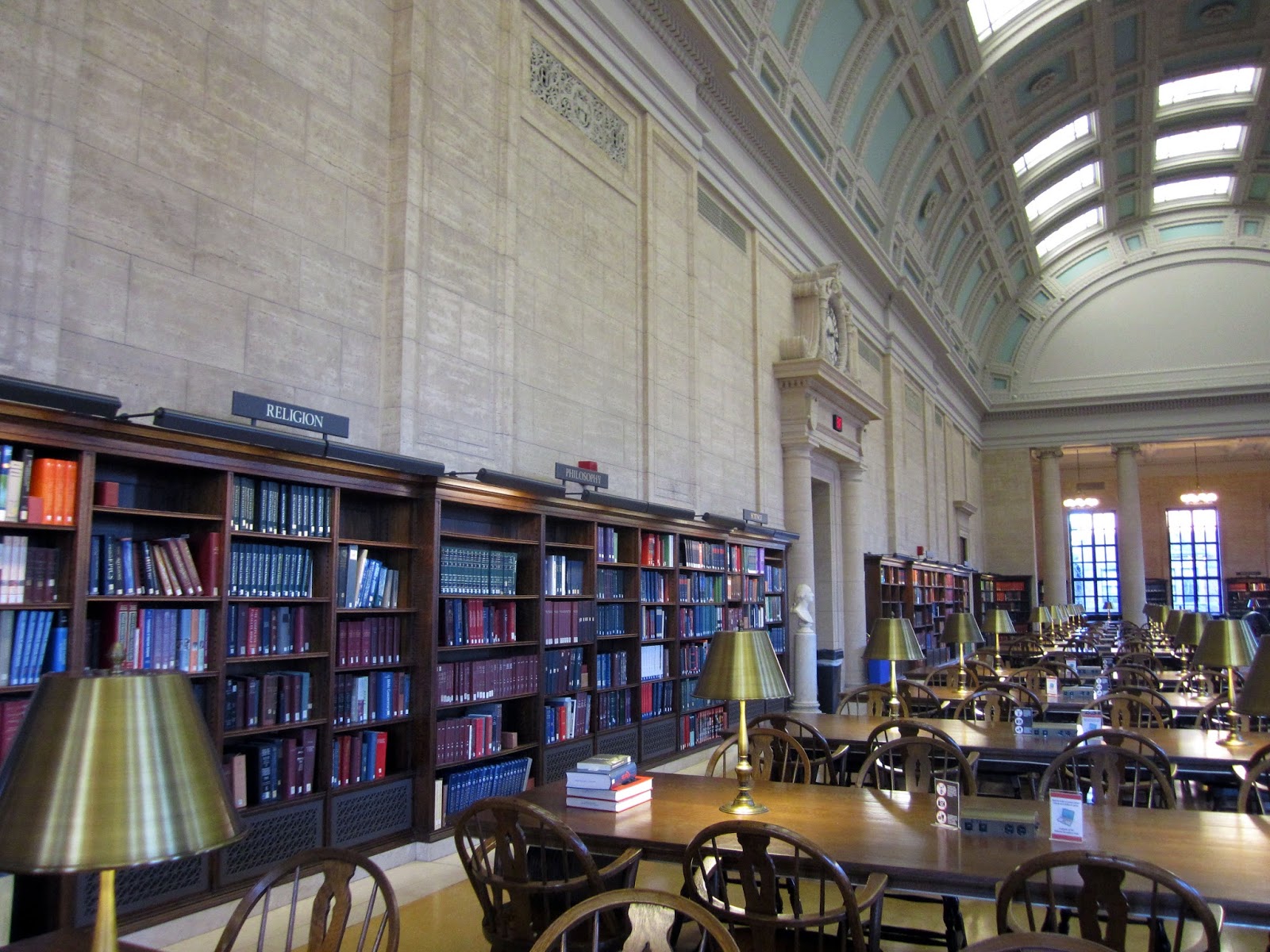
Since I have to open the Widener desk on Wednesdays, I took a bunch of shots before opening.

Loker Reading Room with the barrel vault ceiling.


The reference room (Atkins) with my back to the windows.


The lounge outside Loker and Atkins.

Stairs leading up to level 2.


Entrance to Loker.

Ancient suggestion box.


Monday, December 09, 2013

Wednesday, November 13, 2013

Domestic Mystery

Scene of the crime!


And here are the usual Suspects:


Friday, November 08, 2013

"Romeo's New Plaything" or "Boredom Defeated!"

What will I do today?

I tire of the same old toys.

Hello!  What's this?
This smells just like Mommy's ears!
This is the most awesome toy ever!
I could watch it for hours....

...and then drop it into the water dish until the cotton bits come off.